Every year, Accra holds its breath for the rains. And almost every year, the rains win.
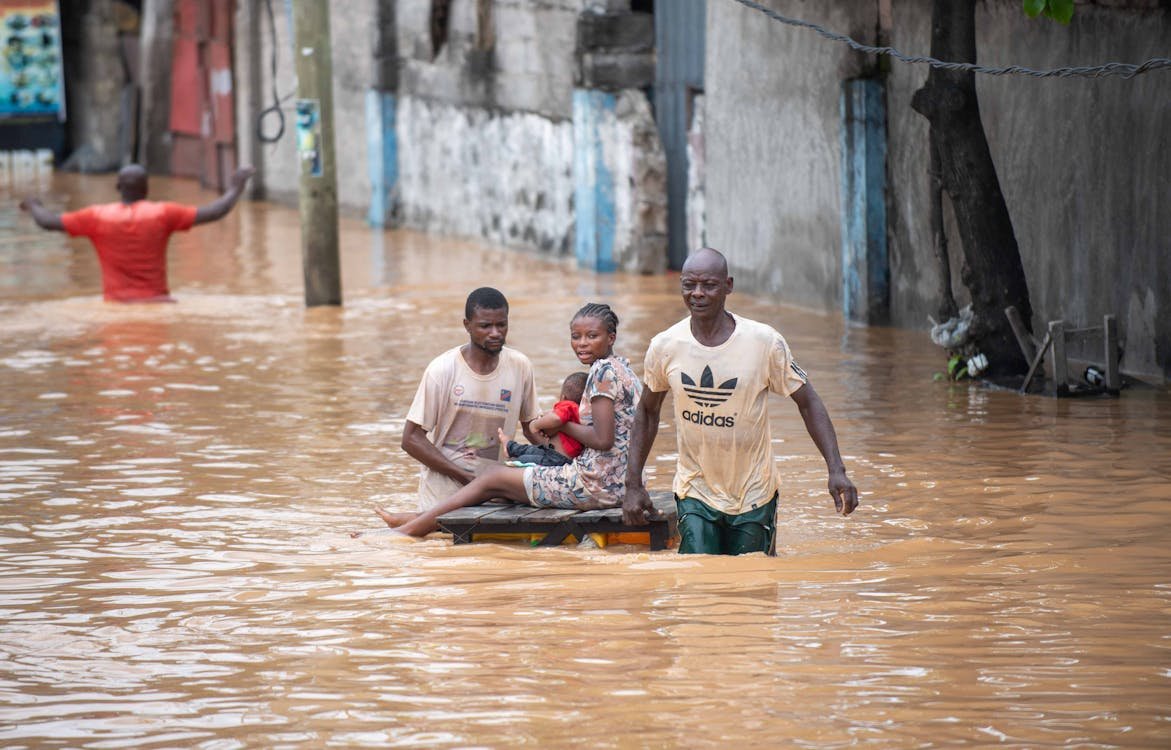
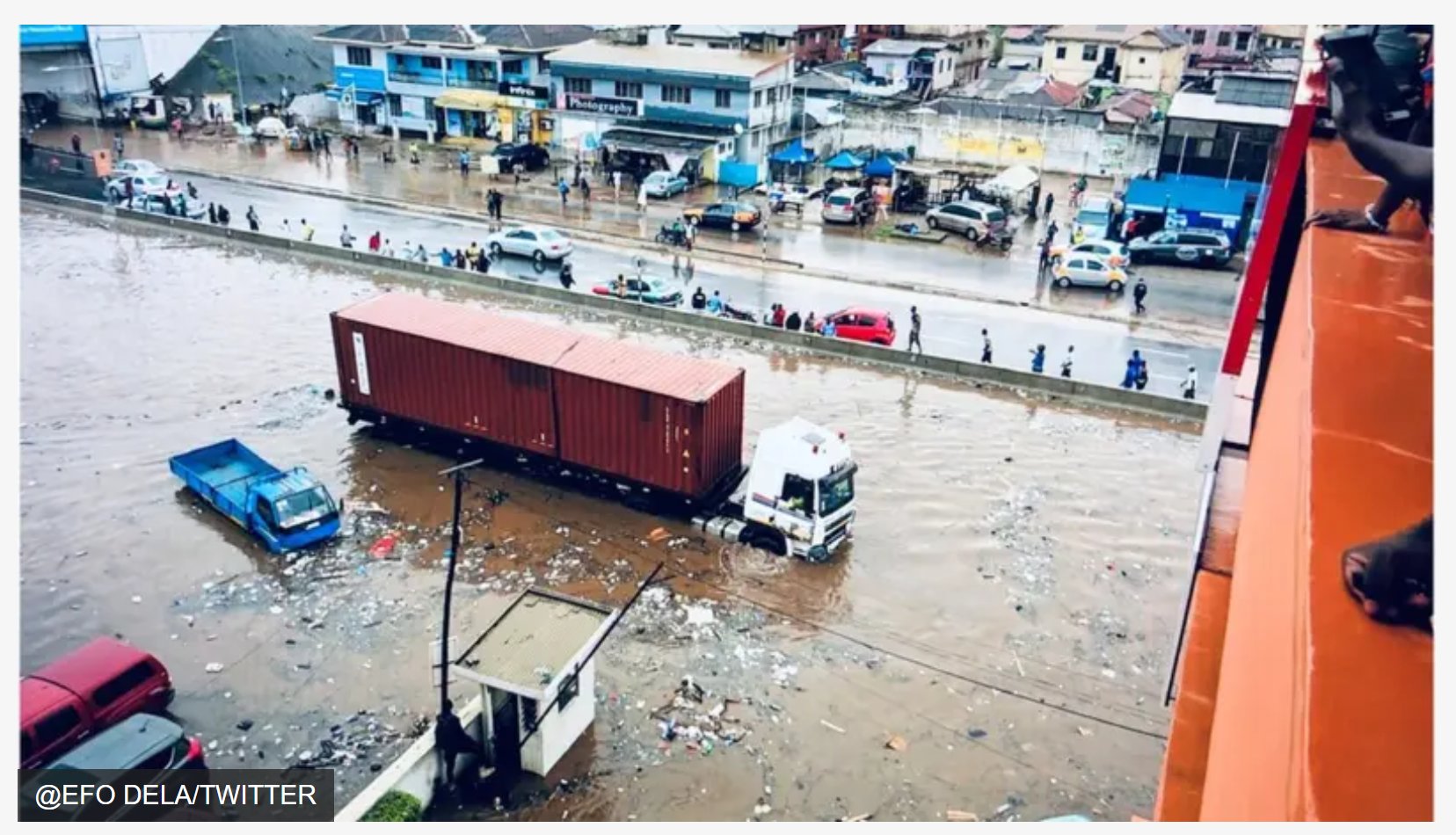
The pattern has become so familiar that it barely interrupts the national conversation anymore. The clouds gather over the Gulf of Guinea, the first heavy downpour of the wet season arrives, and within hours the images circulate: cars half-submerged on the Kaneshie stretch, traders bailing water from stalls at Agbogbloshie, families wading waist-deep through what used to be a street, a child's sandal floating past a stalled taxi. We have a word for it now, spoken with a kind of weary resignation: the perennial floods. As if they were weather. As if they were inevitable.
They are not inevitable. They are built. To understand why Accra floods, you have to understand how Accra grew.
A city that outran its own map
For most of the twentieth century, Accra was a modest coastal town wrapped around a few colonial-era districts, its growth slow enough that the land could absorb it. That is no longer the city we live in. Over roughly the last three decades, the built-up footprint of the Accra metropolis more than doubled, from an estimated 42 square kilometres in 1985 to around 89 square kilometres by 2017, now covering close to two-thirds of the metropolitan area. Step back to take in the whole Greater Accra region and the transformation is even starker: between 2008 and 2017 alone, the urban extent expanded from roughly 411 to 689 square kilometres, a sprawl spreading outward at nearly six percent a year.
Behind that concrete is people. The Accra metropolis counted about 1.66 million residents in 2010; the wider functional city is now estimated at around 2.5 million and climbing toward 2.7 million, while Greater Accra as a region has pushed past four million, more than ninety percent of it urban. Ghana as a whole crossed the threshold into a majority-urban nation, with the share of city-dwellers projected to keep rising for decades. People came, for work, for school, for the simple gravitational pull that capital cities exert on a country's hopes, and they had to live somewhere.
Here is the quiet tragedy at the centre of the story: a great deal of that "somewhere" was land that should never have been built on. As Accra expanded, it did not expand into empty, flood-safe ground. It expanded onto the very surfaces that used to keep it dry. The wetlands that once acted as natural sponges, the riparian buffers along the rivers, the lagoon margins, the open floodplains: these were precisely the cheap, unclaimed, low-lying spaces where a fast-growing, under-housed population settled. Researchers studying the city's peri-urban fringe have documented it in cold numbers: open space, farmland, and wetland shrinking year over year while built-up area surged. Flood risk, as one study put it, was effectively built into the urban fabric.
The Odaw, and what we did to it
No part of this story is more telling than the fate of the Odaw River and its basin, which drains much of central Accra down through the Korle Lagoon to the sea.
A river in a flooding city is supposed to be the solution, the channel that carries the stormwater away. In Accra, the Odaw has been slowly converted from a solution into a hazard. Its banks and floodplain have been steadily encroached upon by housing, markets, and workshops, many of them informal settlements built by people with nowhere else affordable to go. Agbogbloshie and Old Fadama, sprawling along the river near the city centre, became home to tens of thousands. Every structure built in the channel's path narrows the space the water has to move through. Every paved surface upstream means more water arrives faster and with nowhere to soak in.
And then there is the waste. Accra generates on the order of 3,000 tonnes of solid waste a day, and a substantial share of it never reaches a proper disposal site. Much of it ends up in the drains and the river. Plastic, sachet-water bags, bottles, packaging, accumulates in the channels until they choke. When the heavy rain comes, the water meets a drainage system that is simultaneously too small, too silted, and too clogged with refuse to do its job. The Odaw, meant to carry the flood away, instead backs up and spreads it across the neighbourhoods crowded along its banks.
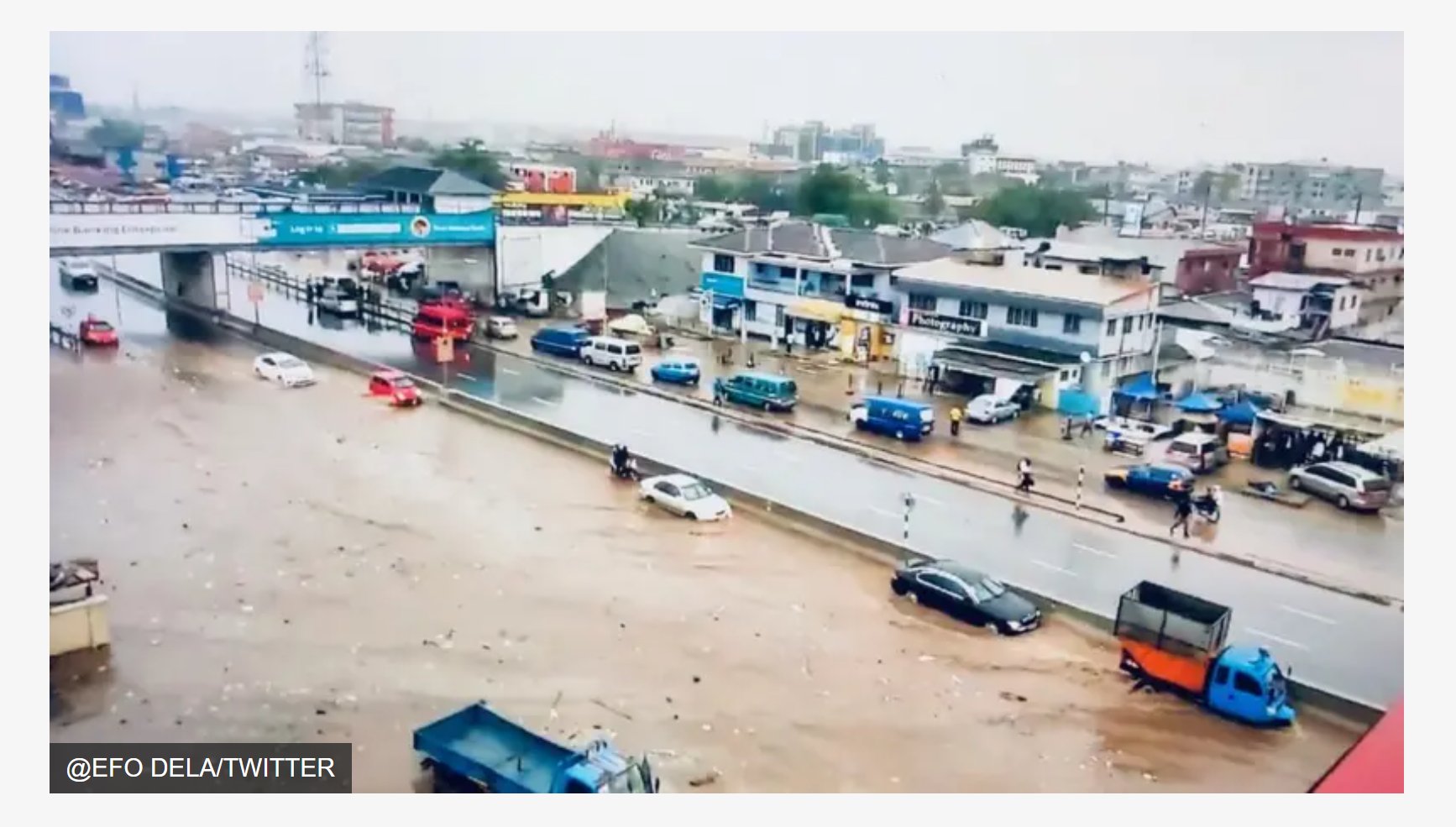
This is the uncomfortable knot at the heart of Accra's floods: it is not one cause but several, braided together. Unplanned growth puts people and property in harm's way. Weak and missing drainage infrastructure cannot cope with the runoff that all the new concrete produces. And everyday human behaviour, building in waterways, dumping waste in drains, actively sabotages what little capacity the system has. Each factor makes the others worse. You cannot blame the rain alone, and you cannot blame any single human failing alone either.
June 3, 2015: the night the flood caught fire
If the perennial floods have a date carved into the national memory, it is June 3, 2015.
That evening, torrential rain submerged large parts of central Accra. Around the Kwame Nkrumah Circle, one of the city's busiest interchanges, floodwaters rose fast, and crowds of people took shelter wherever they could, including at a GOIL fuel station. Fuel leaked and spread across the surface of the floodwater. Then came a spark. The explosion and fire that followed, compounded by the flooding, killed more than 150 people in a single catastrophic night; some estimates of the combined toll ran far higher, and bodies were recovered for days afterward, some from the open drains. The government declared three days of national mourning.
The official inquiry into the disaster traced the chain plainly: the flooding of the Circle was the root cause, the overflow of fuel the intermediate cause, the spark the final trigger. It recommended what people had been saying for years: dredge and desilt the Odaw and its tributaries, build proper drainage, and enforce sanitation rules. The June 3 disaster was a uniquely horrific event, but the flood that set it in motion was not unusual at all. It was the same flood Accra sees most years; it simply met a fuel station and a spark.
What is sobering, looking back across the decade, is how ordinary the flooding around it was. The historical record reads like a drumbeat: serious floods in 2010, in 2011, in 2013, in 2014; the catastrophe of 2015; further deadly flooding in 2016; and on through the years that followed, the wet season rarely passing without streets turning to rivers somewhere in the capital. Studies tracking the relationship between the city's growth and its disasters found flood events rising in step with the unplanned spread of development into the waterways. The floods did not come despite the way we built the city. They came because of it.
The longer record: two decades of warnings
The decade I have been describing did not begin on a clear slate. Pull the record back twenty years and further, and the striking thing is not how new Accra's flooding is, but how old, and how thoroughly it was documented and warned about long before June 3, 2015.
Urban flooding has been recorded in Accra since at least the 1930s, with major disasters logged across the second half of the twentieth century: 1955, 1960, 1963, 1973, 1986, 1991, and a severe event in 1995 whose rainfall was estimated to carry a one-in-fifty-year return period. By the turn of the millennium the events were coming thick and fast. In June 2001, a torrential early-morning downpour submerged parts of the city, leaving around eleven people dead and, by one account, more than a hundred thousand displaced across districts like Madina, Achimota, Dzorwulu, and Adabraka. In 2007, catastrophic floods further north affected over 300,000 people. Then came a relentless run in the capital and beyond: havoc across central Accra in May 2010; what was then called the nation's worst recent flood disaster in June 2010, with thirty-five dead; further downpours and destruction in February and again in November 2011, the latter killing fourteen people and displacing some seventeen thousand in a matter of days; serious flooding in 2013; and the now-familiar deluge of June 2014 that exposed, yet again, the city's poor planning, a full year before the disaster that would finally force the issue.
Read in sequence, this is not a list of freak accidents. It is a city being warned, over and over, in language no one could misread. Researchers writing in the years before 2015 were already estimating that the total value of assets at risk from flooding in Accra exceeded six million US dollars a year, up sharply from earlier in the decade, and that the annual cost of flood damage was roughly doubling. The knowledge was there. The studies were there. The recommendations, dredge the Odaw, build and maintain drains, stop building in the waterways, enforce the sanitation laws, were there, repeated in report after report. What was missing was sustained action.
Is it getting worse, and what does that predict?
This is the question that matters most, and it deserves an honest answer rather than an alarming one.
The short version: yes, the underlying conditions are trending in the wrong direction, but the dominant reason is us, not the sky, and that distinction is the whole point.
On the rainfall itself, the signal is real. Analyses of Accra's records show an increasing trend in heavy-rain days, days with rainfall above the 20 mm threshold, across the four decades from 1980 to 2020, and climate projections for the Greater Accra region point the same way: under a range of future scenarios, the intensity and duration of extreme-precipitation events are expected to rise, even as the total number of rainy days may fall. In plain terms, the rain is arriving in fewer but heavier bursts, exactly the pattern that overwhelms drainage built for a gentler era. A warmer atmosphere holds more moisture, and the downpours grow more violent. So the hazard side of the equation is, genuinely, intensifying.
But here is the crucial finding, and it comes from careful Ghanaian research rather than assumption. When scholars examined the rising flood situation in urban Ghana and asked directly whether climate change was to blame, the answer was that the worsening floods are largely independent of climate-driven rainfall change and strongly linked instead to human factors: unregulated urban expansion, inadequate drainage, poor solid-waste management, and weak institutional enforcement. Climate change is loading the dice. But it is the way we have built and run the city that determines whether a heavy rain becomes a manageable inconvenience or a deadly flood. The same downpour that drains away harmlessly in a well-planned city kills people in one where the wetlands are paved, the drains are choked, and the floodplains are crowded with homes.
That is why the trajectory is genuinely worrying. The two forces are compounding. The rainfall is becoming more extreme at the very moment the city is becoming more vulnerable: more concrete, more people in harm's way, more waste in the channels, more wetland lost each year. Layer an intensifying hazard on top of a rising exposure and the maths runs only one direction. If nothing changes, the prediction embedded in the data is not subtle: the events will keep coming, and the worst of them will be worse than what we have seen. June 3, 2015 was not a ceiling. It was a warning shot. The next convergence of an extreme downpour with a dense, unprotected, badly drained settlement does not need a fire to be catastrophic. The water alone, arriving fast enough and high enough where enough people live, is sufficient.
The encouraging mirror image of that grim arithmetic is this: because the dominant driver is human, the outcome remains, for now, within human power to change. A hazard we cannot control is being amplified by an exposure we can. That is precisely where the leverage lies.
What we have tried, and why the water keeps returning
It would be unfair to say nothing has been done. The scale of the 2015 disaster forced a reckoning, and out of it came the most serious response Accra has yet mounted: the Greater Accra Resilient and Integrated Development project, GARID, launched with World Bank backing, an initial $200 million approved in 2019, topped up by a further $150 million in 2023, with works running through the mid-2020s. It is Ghana's largest urban resilience programme, aimed squarely at the Odaw basin: dredging the river, upgrading drains, improving solid-waste management, building an early-warning system, and protecting well over 100,000 households in the low-income communities most exposed to the water. By early 2024 the dredging of the Odaw had begun in earnest, a four-year undertaking; by 2025, key drains were taking shape and the World Bank was reporting visible progress.
Alongside the engineering has come the bulldozer. Authorities have repeatedly moved to demolish structures built on the waterways, clearing the channel so the water can pass. In the cleared zones, the flooding has measurably eased. But this blunt instrument cuts both ways. The demolitions have displaced thousands of people, over ten thousand in some operations around the Odaw, often without adequate relocation or support, and frequently falling hardest on the poorest residents while wealthier developers received gentler treatment. The clearances have sparked protest and a deep sense of injustice. And where drainage upgrades have not followed the demolition, the flooding has simply persisted.
This points to the hardest truth in the whole story, and it is not an engineering truth. Accra's flooding is not merely an act of God or a quirk of climate change. It is, at bottom, a failure of governance and political will. Climate change is real and it is raising the stakes. But the rain is not the variable we control. What we control is where we let people build, whether we maintain the drains, whether we collect the waste, whether the rules on the books are enforced consistently rather than selectively, and whether the people displaced in the name of flood control are treated as citizens with rights or as obstacles to be cleared. Those are choices. Floods are where those choices come due.
Living with water
I write this not as a counsel of despair but as an argument for honesty. Accra's floods are often discussed as a natural disaster, something that happens to the city. They are better understood as a mirror, a once-a-year reflection of decisions made over decades about how a city should grow, who it should make room for, and what it owes the most vulnerable people living in its lowest ground.
The encouraging part is that a problem we built is a problem we can, in principle, unbuild. The wetlands can be protected from further encroachment. The drains can be sized for the city we actually have rather than the town we used to be, and then, crucially, maintained. The waste can be collected so it stays out of the Odaw. The early-warning systems can give families along the river the hours they need to move. And the communities in the floodplain can be brought into the planning as partners to be resettled with dignity, rather than encampments to be demolished on short notice. None of this is simple, and the pace so far has been slow, uneven, and contested. But none of it is beyond us.
For now, though, the rains will come again next season, as they always do. And the question Accra faces is the same one it has faced for a decade: when the water rises, will it find a city that has finally made room for it, or, once more, a city built to drown.
This essay draws on reporting and research on Accra's urban growth and flood history, including land-use and population studies of the Greater Accra Metropolitan Area; the documented historical record of flood events from Ghanaian press archives, NADMO records, and academic reviews; analyses of rainfall trends and climate projections for Greater Accra; the official inquiry into the June 3, 2015 disaster; and documentation of the Greater Accra Resilient and Integrated Development (GARID) project. Figures are drawn from published studies and official sources; verify exact values against the primary sources before formal citation. The essay reflects the author's synthesis and views.